Payroll sync, every payroll cycle
Employment and income data updates each payroll cycle from the payroll system or HCM you already run. This is the lighter lift for many employers, because the feed already exists in some form.
MyEmployment replaces The Work Number for your workforce. You pay nothing. Earn revenue share up to $500,000 a year.










All product names, logos and trademarks are the property of their respective owners. Listing indicates supported connectivity, not partnership or endorsement. If your system is not listed, a one to one API is the alternative.
Many of these requests are answered without ever reaching your HR team. Here is the sequence, start to finish.
A lender, landlord, insurer, debt collector or government program has to confirm that someone holds a job, or what they earn, before a mortgage, a lease, a loan or a benefit can move.
It goes to a verification repository that already holds payroll data for many employers, placed there by a payroll provider, an HCM platform, or an agreement signed at some point in the past.
Credentialed verifiers pay for completed verifications. One of our competitors, Equifax, reports that The Work Number fulfilled 149 million verifications in 2024. That fee is collected by whoever fulfills the request.
Source: that competitor's published reporting, 2024.The answer can be released on the strength of a form signed days, weeks or months earlier. The employee may receive no notice at the moment it happens.
Follow the fee, today
In many arrangements, none of that fee comes back to the employer whose workforce the answer describes, and the employee is not asked at the moment it is released.
Follow the fee, with MyEmployment
Same category of request. What changes is who gets asked, who controls the release, and who is paid.
Employees×1.2×$59
Your revenue pool comes from three inputs: your headcount, about 1.2 verifications per employee a year, and the price verifiers pay, $59 or $69. That 1.2 counts former employees too.
Enter your headcount to view the estimated gross transaction pool generated by your workforce. Revenue share is negotiated individually in your employer agreement. Change the rate if you know your actual volume.
Estimated annual verifier fee pool
$141,600
Your revenue share
Negotiated in your employer agreement
The figure above represents the annual gross transaction pool. Your monthly revenue share is a negotiated portion of this pool, set directly in your agreement.
That is $70.80 per employee per year. In many arrangements that money goes to an outside vendor today.
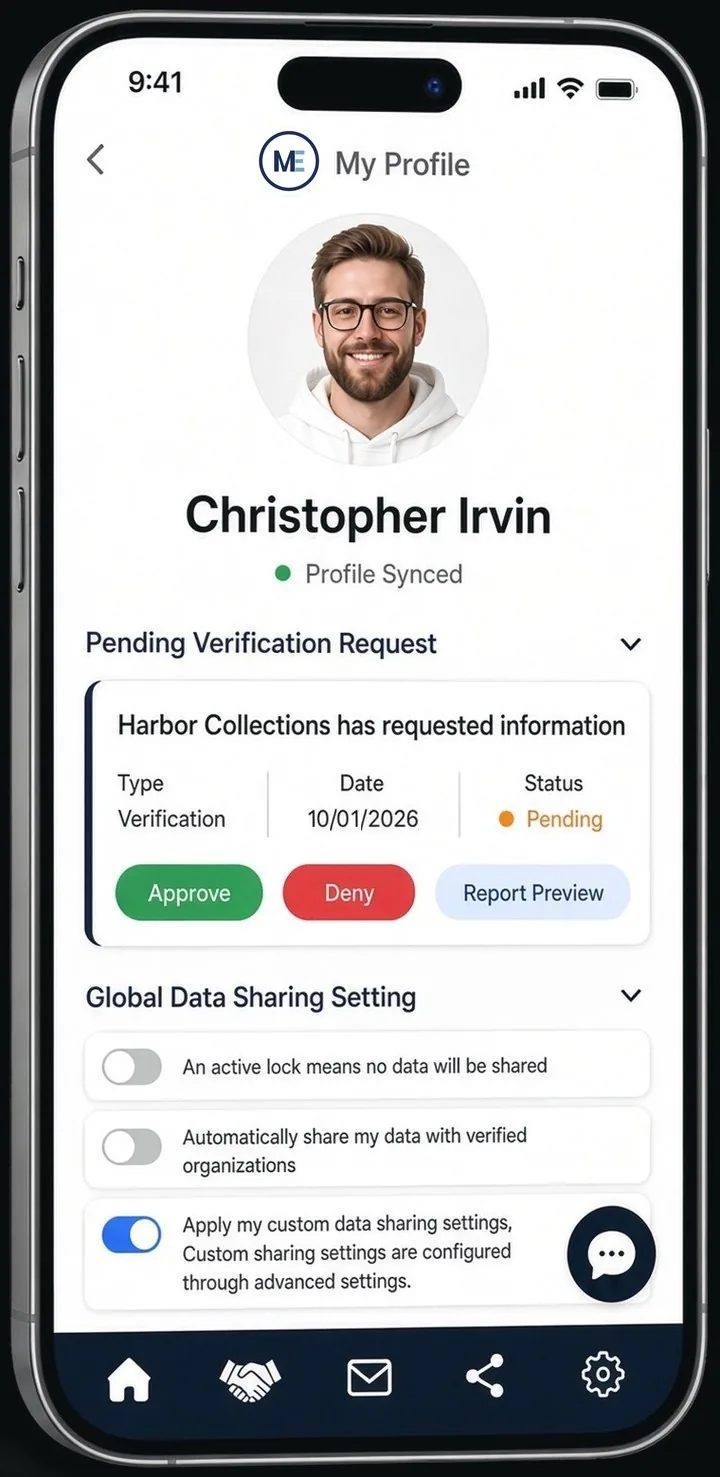
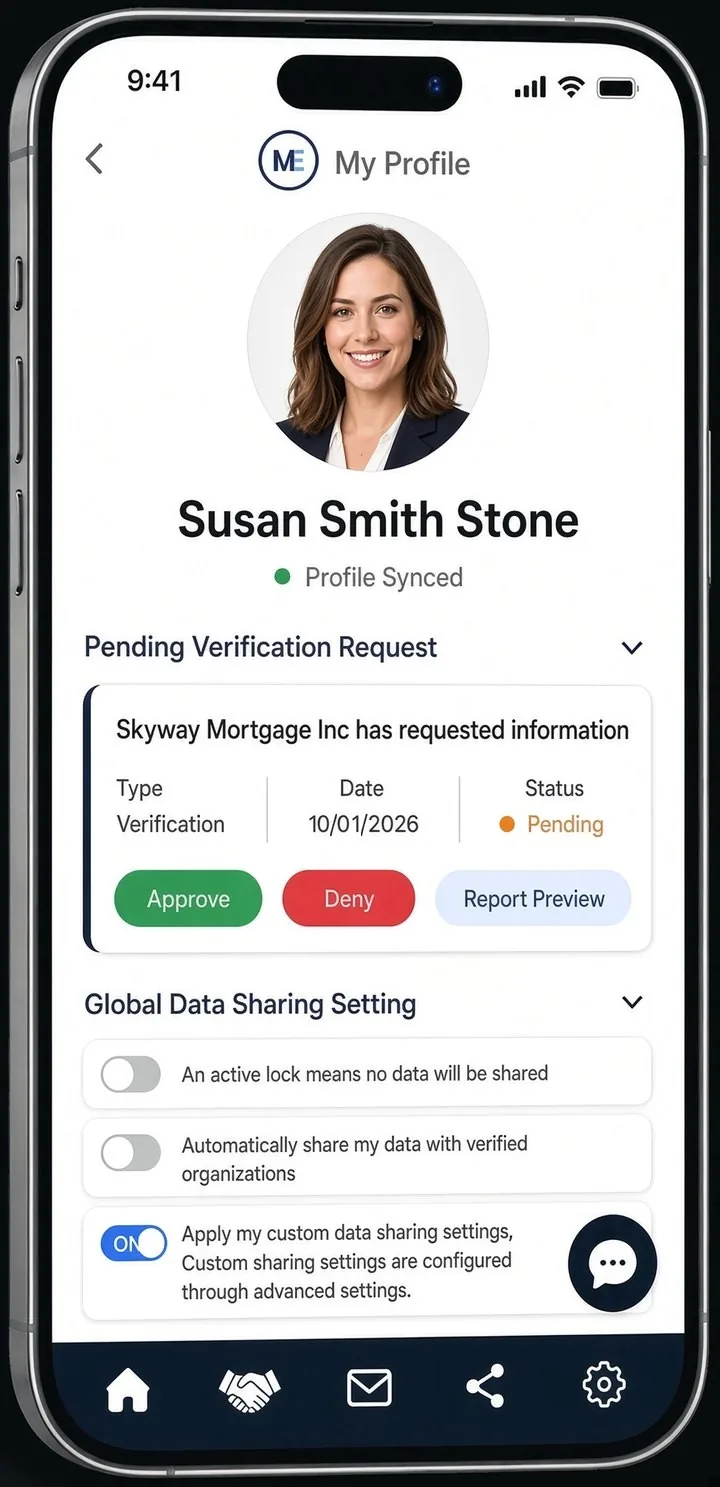
Employment verification comes up during a mortgage, a lease, a new job or a benefits application. MyEmployment gives your employee notice when a request arrives and a clear role in how their information is handled.
The employee sees the requester, the stated purpose, and what was requested.
An enrolled employee decides on each request as it arrives, and can set defaults in advance so routine requests move without interruption.
If the employee does not respond within it, or is not enrolled, MyEmployment answers where the verifier has a permissible purpose under the FCRA. One employee's silence does not stall someone else's mortgage.
Debt collection and skip tracing requests proceed only on the affirmative approval of the employee or former employee. A nonresponse never authorizes those releases.
Requests, decisions and outcomes are recorded for the employee and for you.
Employees are not required to enroll for requests to keep clearing. Enrollment is what gives them the notice, the decision and the record.
You pick the access method and can change it later. Nothing about the choice is permanent, and nothing about the switch requires requests to stop clearing.
Employment and income data updates each payroll cycle from the payroll system or HCM you already run. This is the lighter lift for many employers, because the feed already exists in some form.
A direct connection into your systems, answered against your own data at the moment of the request.
Your HRIS or payroll platform remains the system of record. MyEmployment connects to the source you designate and answers eligible requests against it.
Requests arrive in formats no integration covers. Those are worked on your behalf, so there is no window where incoming verification requests go unanswered.
In many payroll environments, switching off an existing verification feed is a configuration change at the payroll provider rather than a project. MyEmployment identifies who to contact and walks you through the steps, and requests keep clearing while the change is made.
The questions Finance, HR, Legal and IT may raise first, answered here so whoever did not take the call finds their own objection addressed.
Credentialed verifiers pay for completed verifications. The employer agreement sets the negotiated share, and payment is made monthly for the length of the agreement, with a reconciliation of the completed verifications behind it. During the introductory call the figure is modeled against your own headcount and your current vendor's volume report. You pay nothing.
There is no employer platform fee and no charge to employees. Your existing HRIS and payroll systems stay in place. Anything specific to your environment is identified during the evaluation rather than after signature.
An enrolled employee receives notice when a verification request arrives, sees the requester and the stated purpose, and decides on it. There is no forced mass enrollment, and employees who do not enroll do not prevent eligible requests from being fulfilled.
Routine incoming requests are fulfilled through the access method you choose rather than by hand. If your team answers verification calls and forms today, that is the work that moves.
Verifier access is limited to credentialed parties presenting a documented permissible purpose under the FCRA. Employer policy can further limit which request types are eligible. Every request, decision and outcome is recorded.
Verifier access is limited to credentialed parties with a documented permissible purpose, every request and outcome is written to an audit trail, and access and retention are defined contractually. MyEmployment has completed a SOC 2 Type 2 examination, and the report and supporting security materials are available during the review.
What this is
Consent-based employment verification gives the employee visibility and control at the moment a request arrives. MyEmployment identifies the requester and the stated purpose, notifies the enrolled employee or former employee, and gives that employee the opportunity to approve or deny that specific request. MyEmployment does this for an employer's existing and former workforce. It does not replace pre-hire background screening.
Authorization and permissible purpose are not the same thing in every context, and the legal basis a verifier needs depends on why they are asking. What MyEmployment adds is request-time visibility. Consider someone who applies to three apartments and signs an authorization for each. They take one lease. The other two still hold a signed authorization, and a request from either can be answered without the applicant hearing about it. An enrolled employee sees that a request was made, who made it, the stated purpose and what was requested, and decides on it.
Yes. MyEmployment handles incoming employment and income verification for your current and former workforce, in place of the outside service that handles it today, if you use one. Your HRIS or payroll platform stays in place, and MyEmployment does not replace your pre-hire background screening. Your company receives a negotiated share of the fees those requests generate.
No. MyEmployment handles incoming employment and income verification concerning an employer's existing and former workforce. It does not replace the employer's pre-hire background screening program.
MyEmployment estimates about 200 million a year, automated and manual combined3. One provider alone reported 149 million in 2024, up from 144 million in 2023.
Source: One provider alone reported 149 million in 2024 (144 million in 2023), per that competitor's published reporting.At least 839 million employee records sit in these repositories, from more than 5 million employers. Many employers may not be aware they contribute, because contribution can be included in a payroll service agreement.
Source: one provider's own figures, its homepage, September 2026.Many verification workflows give the employee no new notice at the moment a request is answered. The verifier may already hold the authorization or other permissible purpose required for that transaction, signed days, weeks or months earlier. MyEmployment adds request-time visibility for enrolled employees, including who asked, the stated purpose, and a record of the decision.
What it costs and what you earn
MyEmployment does not charge the employer a platform fee, and does not charge employees. Credentialed verifiers pay for completed employment and income verifications.
A standard employment verification is $59. An income verification is $69.
In many arrangements the employer receives nothing today, because the fee is collected by whoever fulfills the request. Each completed verification is a paid transaction. Under a MyEmployment agreement, a negotiated share of what the verifier pays is returned to the employer, paid monthly for the length of the agreement. The amount depends on workforce size, turnover and verification volume.
Up to $500,000 a year is an illustration for a large employer. The actual revenue share is negotiated individually and depends on workforce size, turnover, verification volume and the terms of the employer agreement.
It is paid monthly for as long as your company is on the platform.
How it runs
The employer selects the access method and can change it later. One option is a payroll sync that updates with the payroll cycle. The other is a direct API into the source system the employer designates. Requests arriving by phone, fax or paper are worked on the employer's behalf.
It depends on the payroll environment and the current arrangement. In many payroll environments the verification configuration is changed through the payroll provider rather than through a project. MyEmployment identifies the applicable contacts and coordinates the transition with the employer.
The employer sets the response window. If an enrolled employee does not respond within it, or the employee is not enrolled, MyEmployment may fulfill the request where the verifier is credentialed and the legal requirements applicable to that request have been satisfied. One employee's silence does not stall someone else's mortgage. Enrolled employees keep a record of the request and the outcome. Debt collection and skip tracing requests are the exception: they never release on a nonresponse and require the affirmative approval of the employee or former employee. The employer remains the furnisher. MyEmployment is the fulfillment agent.
The record is not released. A denial blocks release in every request category. The verifier is told the request was not approved. The only exception is a release compelled by subpoena or other legal process. Employees can set defaults in advance so routine requests move without interruption.
The employer remains the furnisher and the source of the employment and income record. The HRIS or payroll platform remains the system of record. MyEmployment is the fulfillment agent. It fulfills requests against the source the employer designates, under the employer agreement and the FCRA.
Yes. Former employees remain eligible for incoming employment and income verification for the length of the employer agreement. There is no separate cutoff at termination. Enrollment is still what gives them notice, a decision and a record. The employer pays nothing and the former employee pays nothing.
A payroll sync is a configuration and a feed, measured in days to a few weeks once the payroll contact is identified. A direct API depends on the employer's own systems team and security review. Requests keep clearing during the change.
MyEmployment operates under the Fair Credit Reporting Act. Verifier access is limited to credentialed parties presenting a documented permissible purpose, employer policy can further limit which request types are eligible, and every request, decision and outcome is recorded. The requirements that apply to any one request depend on the purpose for which the verification is being obtained.
Yes. MyEmployment has completed a SOC 2 Type 2 examination. The report is available on request during the security review.
“In 2022 I sold a firm that had purchased millions of employment and income verifications. I paid. I received the file. The employee was rarely if ever notified when I asked. Many employers I dealt with received nothing from the fee.”
Protect your employees. Share in the revenue. We model it on your own numbers, then schedule a 15-minute call to walk you through it.
Evaluating this with an association, a group purchasing organization or a peer group? Tell your MyEmployment representative and we will walk the group through the same model.
Thank you. We'll reach out to schedule your 15 minute call and walk through your estimate using your own numbers.
No cost and no obligation.